Enjoy!
Honda Search Engine

Custom Search
Showing posts with label civic. Show all posts
Showing posts with label civic. Show all posts
Wednesday, November 25, 2009

Tuesday, November 24, 2009
Delta Camshaft Non-Vtec D15/D16 Cam specification sheets
Here are the specification sheets for the Delta 260 and Delta 272 camshafts.


Monday, November 23, 2009
Honda Civic/CRX D15B1/D15B2 MPFI Swap
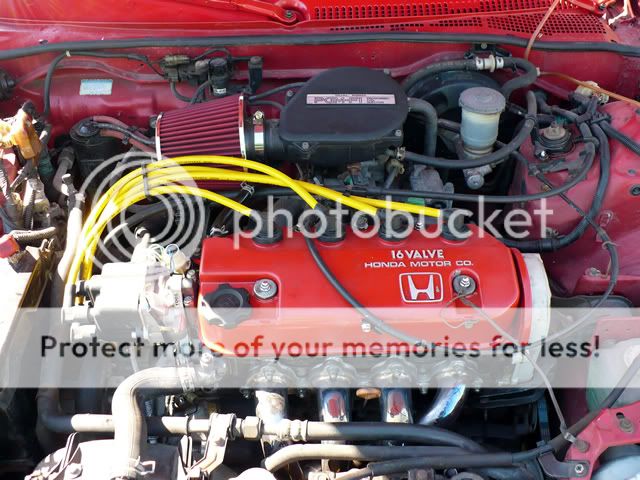
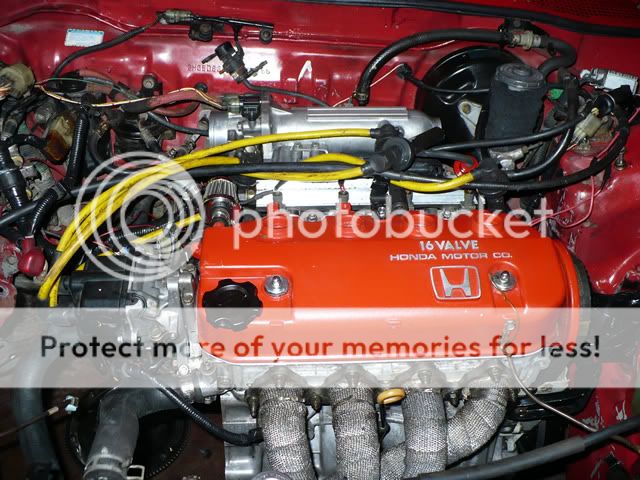
The MPFI swap is one of the best ways to gain more performance out of a Honda D15B1 or D15B2. The stock DPFI system is a true bottleneck for the engine due to the small diameter of the throttle body and the poor flow rate of the injectors. Another downfall is that the DPFI ECU's have not been cracked, so they cannot be tuned. Any modifications done to the engine (ex. cold air intake/exhaust) will be useless with DPFI, and any gains in power will be minimal at most.
This tutorial is geared towards OBD-0 setups. OBD-1 conversions will not be covered here.
Parts Required:
1. A complete intake manifold from an MPFI Engine. I recommend the D16Z6, but the D16A6, D16Y8, and D15B7 can also be used.
2. MPFI ECU. You will need a pm6, pr4, or pg7 (note: will run rich with pr4 and pg7). Make sure you replace the OBD-1 injectors with OBD-0 injectors if using a D16Z6, D16Y8, or D15B7 intake manifold.
3. MPFI Distributor TD-02. The stock DPFI TD-01 distributor will not work.
4. Resistor Box: This can be pulled from a Civic/CRX Si
5. Four MPFI injector plugs, 7 pin Si distributor plug, resistor box plug.
6. New intake manifold gasket
7. Si throttle cable. (Not absolutely necessary, but it is much better over the long DPFI cable)
I highly recommend soldering and heatshrink wrapping ALL connections.
The best place I have found to start is at the ECU.
Here is a pin-out diagram for the MPFI OBD-0 ECU:

Inside car at the ECU plug:
1. Pins B10 and B12 are empty. Unused pins can be taken from B2 or B11. Some models have a wire located at B12.
2. Cut orange and white wires off at C1 and C2 and connect them to wires added at B10 and B12. Orange-B10. White-B12. Leave enough wire for next step.
3. Run wires from C1 and C2 (direct ECU connection) into the engine compartment. Label these wires for later use.
4. Cut wires at A3 and A7 leaving plenty of wire. Run these wires into the engine compartment and label them for later use.
Next move on to the engine bay:
1. TPS and EACV plugs are too short and must be extended.
2. Be sure to switch green/white and yellow/white wires on TPS. If you do not do this, it will read WOT when the throttle is closed.
Injectors and injector resistor box:
1. Connect the yellow/black wires from the two DX injector harnesses and run it to the yellow/black wire on the injector resistor box.
2. Connect the yellow wire from the DX injector to the #1 injector (brown wire).
3. Connect the red wire from the DX injector and run it to the #3 injector (blue wire).
4. Connect the A3 wire to the #2 injector (red wire).
5. Connect the A7 wire to the #4 injector (yellow wire).
6. Connect the 4 red/black wires from injector resistor box to each injector.
Distributor Cylinder position sensor:
1. Connect C1 to blue/green wire on cylinder position sensor plug.
2. Connect C2 to blue/yellow wire on cylinder position sensor plug.
That's about it, the swap is fairly straightforward. Fire it up! Check the ecu for codes, and do whatever idle adjusting is needed. Good luck to you!
Honda D15B2 Specifications
The Honda D15B2 is one of the most common engines built by Honda. It came in the USDM 4th generation Civic DX hatchbacks, DX sedans, and LX sedans. Also came in the 2nd generation CRX DX's. It shares many similarities with the D15B1 and D15B7's also.
In stock form, it produces a meager 92hp. Great for fuel economy, but bad for performance. Surprisingly enough though, the engine can be built to perform quite well without the use of forced induction or nitrous. There are many options for this engine, everything from upgraded OEM parts to aftermarket parts.
Factory Bottom-End Specifications:
Displacement : 1,493 cc (91.1 cu in)
Cylinder Bore: 75.00mm
Stroke: 84.50mm
Deck Height: 212.00mm
Connecting Rod Length: 134.00mm
Pistons: pm3
Piston compression height: 30.70mm flat top, 4 valve reliefs
Cylinder Head:
Valves: 16
Valvetrain : SOHC (4 valves per cylinder)
Combustion Chamber Volume: 38.00cc
Compression Ratio: 9.2:1
Intake and Electrical:
Fuel System: Dual Point Fuel Injection (DPFI)
Fuel Control : OBD-0 DPFI
Performance:
Horsepower: 92hp at 6000rpm
Torque: 88 ft·lb at 4500rpm
Redline : 6500 rpm,6800 rpm rev limiter
ECU Code: PM5/P04
Average Combined Fuel Economy: 38mpg
In stock form, it produces a meager 92hp. Great for fuel economy, but bad for performance. Surprisingly enough though, the engine can be built to perform quite well without the use of forced induction or nitrous. There are many options for this engine, everything from upgraded OEM parts to aftermarket parts.
Factory Bottom-End Specifications:
Displacement : 1,493 cc (91.1 cu in)
Cylinder Bore: 75.00mm
Stroke: 84.50mm
Deck Height: 212.00mm
Connecting Rod Length: 134.00mm
Pistons: pm3
Piston compression height: 30.70mm flat top, 4 valve reliefs
Cylinder Head:
Valves: 16
Valvetrain : SOHC (4 valves per cylinder)
Combustion Chamber Volume: 38.00cc
Compression Ratio: 9.2:1
Intake and Electrical:
Fuel System: Dual Point Fuel Injection (DPFI)
Fuel Control : OBD-0 DPFI
Performance:
Horsepower: 92hp at 6000rpm
Torque: 88 ft·lb at 4500rpm
Redline : 6500 rpm,6800 rpm rev limiter
ECU Code: PM5/P04
Average Combined Fuel Economy: 38mpg
Subscribe to:
Posts (Atom)